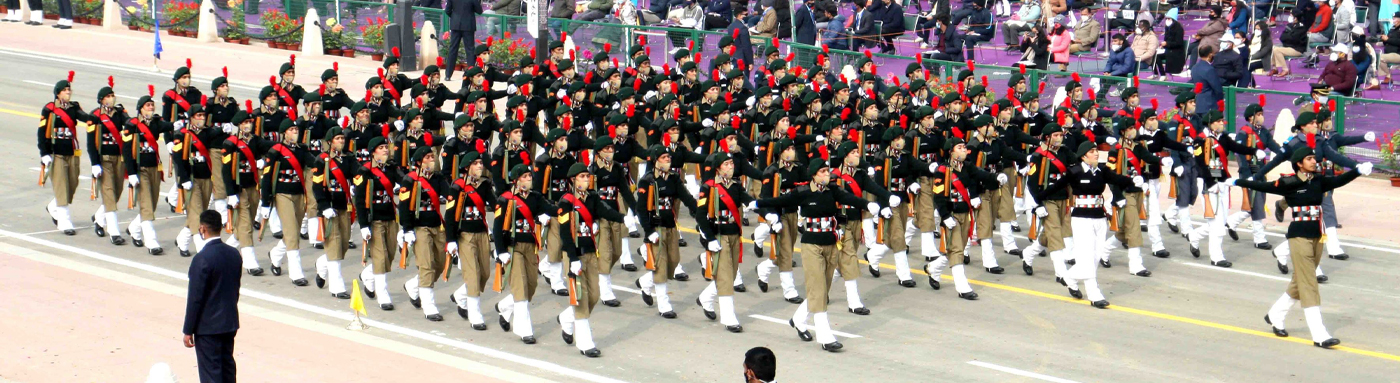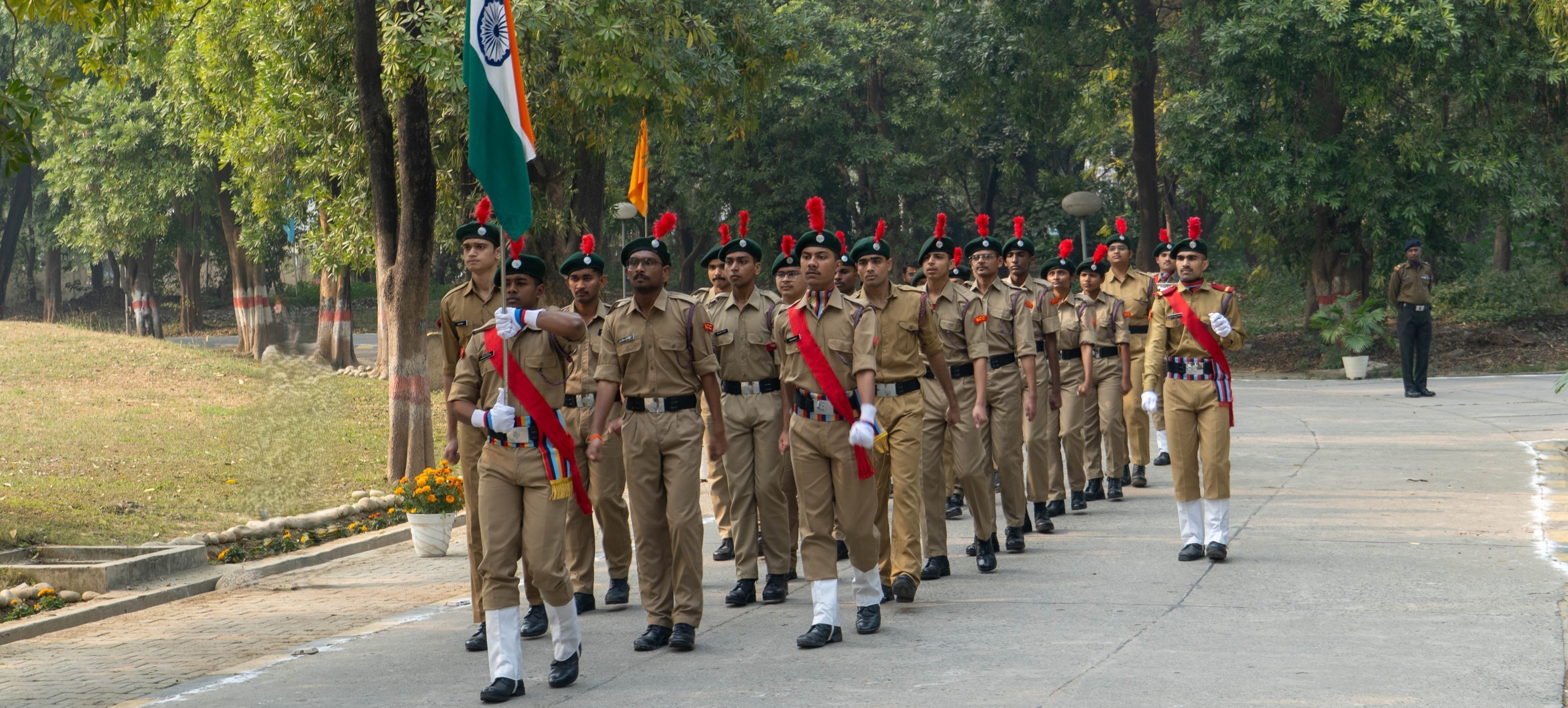
The largest uniformed youth organization in the world, dedicated to grooming the youth of India into disciplined and patriotic citizens.
The National Cadet Corps in India is a voluntary organization which recruits students from high schools, colleges and universities all over India. These students are called Cadets after joining the organization. This is the biggest organization in India, where about 12 lakhs students are enrolled every year. They are given basic military training in small arms and parades. The officers and cadets have no liability for active military service once they complete their course but are given preference over normal candidates during selections based on the achievements in the corps.
National Cadet Corps in IIIT Allahabad has NCC activities that have evoked much enthusiasm among the students. At present, the Army Wing in our college comprising 56 (SD and SW) cadets are actively indulging in all NCC activities to make our college and the nation proud.
"Unity and Discipline"
एकता और अनुशासन
Raised on 15 July 1948 under the National Cadet Corps Act
The mission and vision of our NCC wing is to create awareness among the student community regarding its importance towards nation building. Besides, an NCC cadet is presented with a plethora of job opportunities in reputed government and public sector concerns. We intend to train students to participate in the Republic Day parade and pupils exchange program. IIIT Allahabad NCC wing contributes to the overall personality development of a person and mentally equips them to face the various challenges they may encounter in life.
1. To develop qualities of character, courage, comradeship, discipline, leadership, secular outlook, spirit of adventure and sportsmanship and the ideals of selfless service among the youth to make them useful citizens.
2. To create a human resource of organized, trained and motivated youth to provide leadership in all walks of life including the Armed Forces and be always available for the service of the nation.
The motto was adopted in the 12th Central Advisory Committee meeting held on 12 October 1980.
The need for having a motto for the Corps was discussed in the 11th Central Advisory Committee (CAC) meeting held on 11 August 1978. The mottos suggested were "Duty and Discipline", "Duty, Unity and Discipline", "Duty and Unity", and "Unity and Discipline". The final decision for selection of "Unity and Discipline" as motto for the NCC was taken in the 12th CAC meeting held on 12 October 1980.
The NCC is a responsive and continuously evolving organization. Its activities are guided by certain core values that we endeavor to instill among all ranks of the NCC.
"I do hereby solemnly promise that I will serve my motherland most truly and loyally and that, I will abide by the rules and regulations of the National Cadet Corps. Further, under the command and control of my commanding officer I will participate in every camp most sincerely and wholeheartedly."
"We, the cadets of the National Cadet Corps, do solemnly pledge that we shall always uphold the unity of India. We resolve to be disciplined and responsible citizens of our nation. We shall undertake positive community service in the spirit of selflessness and concern for our fellow beings."
The NCC in India was formed with the National Cadet Corps Act of 1948. It was raised on 15 July 1948. The National Cadet Corps can be considered as a successor of the University Officers Training Corps (UOTC) which was established by the British in 1942. During World War II, the UOTC never came up to the expectations set by the British. This led to the idea that some better schemes should be formed, which could train more young men in a better way, even during peace times.
A committee headed by Pandit H.N. Kunzru recommended a cadet organization to be established in schools and colleges at a national level. The National Cadet Corps Act was accepted by the Governor General and on 15 July 1948 the National Cadet Corps came into existence.
During the 1965 and 1971 wars with Pakistan, NCC cadets were the second line of defense. They organized camps to assist the ordinance factories, supplying arms and ammunition to the front, and also were used as patrol parties to capture the enemy paratroopers. The NCC cadets also worked hand in hand with the Civil Defence authorities and actively took part in rescue work and traffic control. After the 1965 and 1971 Indo-Pak wars the NCC syllabus was revised. Rather than just being the second line of defense, NCC syllabus laid a greater stress on developing qualities of leadership and Officer-like qualities.